Manual Hay Baler: A Comprehensive Overview
Manual hay balers represent a pivotal tool in agricultural efficiency‚ streamlining hay production for farmers and horticulturists throughout history. These devices compress crops into manageable bales.
Manual hay balers stand as essential equipment in agriculture‚ fundamentally altering how crops like hay‚ flax‚ and silage are gathered and preserved. More than just tools‚ they symbolize agricultural progress and efficiency‚ compressing cut and raked crops into compact‚ easily handled bales. This process isn’t merely about convenience; it’s about preserving the nutritional value inherent within the bundled plants‚ ensuring feed quality for livestock.
Historically‚ these balers evolved from simpler hay presses‚ marking a significant leap in farm productivity. Understanding their operation and historical development provides valuable insight into sustainable farming practices. The hand hay baler’s impact extends beyond the field‚ representing a connection to agricultural traditions and a commitment to efficient resource management. They are a cornerstone of many small farms even today.
Historical Development of Hay Balers
The story of today’s hay balers begins in the mid-1800s with the advent of early hay presses. These weren’t the mobile machines we know now‚ but rather stationary installations‚ often towering two or three stories high within barns and haylofts. Initially‚ horsepower wasn’t from an engine‚ but from horses themselves! They powered these presses by lifting and dropping weights‚ compressing the hay with each descent.
This marked a crucial step in streamlining hay gathering and organization. As technology advanced‚ these stationary presses evolved‚ eventually leading to horse-powered balers and‚ ultimately‚ the self-contained units that revolutionized farming. The square baler dominated for decades‚ until the 1970s brought large round balers and mechanical stacking machines‚ changing the landscape of hay harvesting forever.
Early Hay Presses (Mid-1800s)
The mid-1800s witnessed the birth of the first mechanical hay presses‚ a significant leap forward in agricultural technology. These weren’t portable; they were substantial‚ stationary structures built within barns‚ often reaching impressive heights of two to three stories inside the hayloft. Their purpose was simple: to compress cut and raked crops – primarily hay – into manageable bales for easier handling and storage.
Operation relied heavily on animal power. Horses provided the necessary force‚ diligently lifting and releasing weights to apply the compressive force needed to form dense bales. This system dramatically improved efficiency compared to manual stacking‚ though it was still a labor-intensive process. These early presses laid the foundational groundwork for the automated balers that would follow‚ representing a crucial first step in modern hay production.
Transition to Horse-Powered Balers
Following the initial stationary hay presses‚ a crucial evolution occurred: the development of horse-powered balers. While still reliant on animal strength‚ these machines represented a move towards greater portability and efficiency in the field. The core principle remained the same – utilizing a weight-lifting and dropping mechanism to compress the hay – but the design allowed for operation closer to where the hay was cut and raked.
Horses were harnessed to a system of gears and levers‚ providing the power to operate the baler. This eliminated the need to transport hay to a fixed barn location for pressing‚ saving considerable time and labor. Though still physically demanding‚ this transition marked a significant improvement in workflow‚ paving the way for fully mechanized baling systems in the future. It was a vital step in streamlining agricultural processes.
The Rise of Stationary Hay Balers
The mid-1800s witnessed the emergence of the first practical hay balers‚ initially conceived as stationary installations within barns. These early machines were substantial structures‚ often spanning two or three stories in height within the hayloft. Their purpose was to compress cut and raked crops – primarily hay – into dense‚ manageable bales for easier handling‚ transport‚ and long-term storage.
Operation relied heavily on animal power‚ specifically horses. They would power the baler by lifting a considerable weight and then releasing it to compress the hay below. This method‚ while labor-intensive‚ dramatically improved upon the previous manual methods of stacking hay. Stationary balers represented a significant leap forward in agricultural efficiency‚ laying the groundwork for future innovations in hay harvesting and preservation techniques.
Types of Manual Hay Balers
Manual hay balers encompass small square balers‚ hand-cranked models for smaller farms‚ and pick-up balers—each offering unique designs and functionalities for diverse agricultural needs.
Small Square Balers: Design and Function
Small square balers‚ a cornerstone of manual hay harvesting‚ traditionally dominated the landscape until the 1970s. Their design centers around compressing hay into consistently sized rectangular bales‚ facilitating easy handling and stacking. These balers typically feature a reciprocating knife mechanism that cuts the hay as it enters the bale chamber.
The compression process relies on a series of rollers or belts that gradually tighten around the hay‚ forming a dense‚ compact bale. Crucially‚ these balers often integrate with a side-delivery rake‚ streamlining the collection of cut hay before the baling process begins. This integration minimizes field losses and enhances overall efficiency.
The resulting bales are secured using twine‚ creating a manageable package for transport and storage. While requiring more manual labor than modern alternatives‚ small square balers remain popular for smaller farms and operations prioritizing bale handling convenience and compatibility with existing equipment.
Side-Delivery Rake Integration
The integration of a side-delivery rake with a manual hay baler represents a significant efficiency enhancement in hay production. Traditionally‚ farmers would cut hay with a mower‚ then use a rake to gather it into windrows – long‚ narrow piles. A side-delivery rake takes this a step further‚ delivering the windrow to one side‚ creating a consolidated stream of hay ready for the baler.
This streamlined process minimizes field losses‚ as less hay is left behind during collection. It also reduces the distance the baler needs to travel to pick up each swath‚ saving time and fuel. The rake’s ability to create a consistent‚ dense windrow ensures the baler operates at optimal capacity‚ producing tightly packed‚ uniform bales.
For manual balers‚ where operator effort is a key factor‚ this integration is particularly valuable‚ reducing physical strain and maximizing output. It’s a classic example of how combining simple technologies can dramatically improve agricultural productivity.
Hand-Cranked Balers for Small Farms
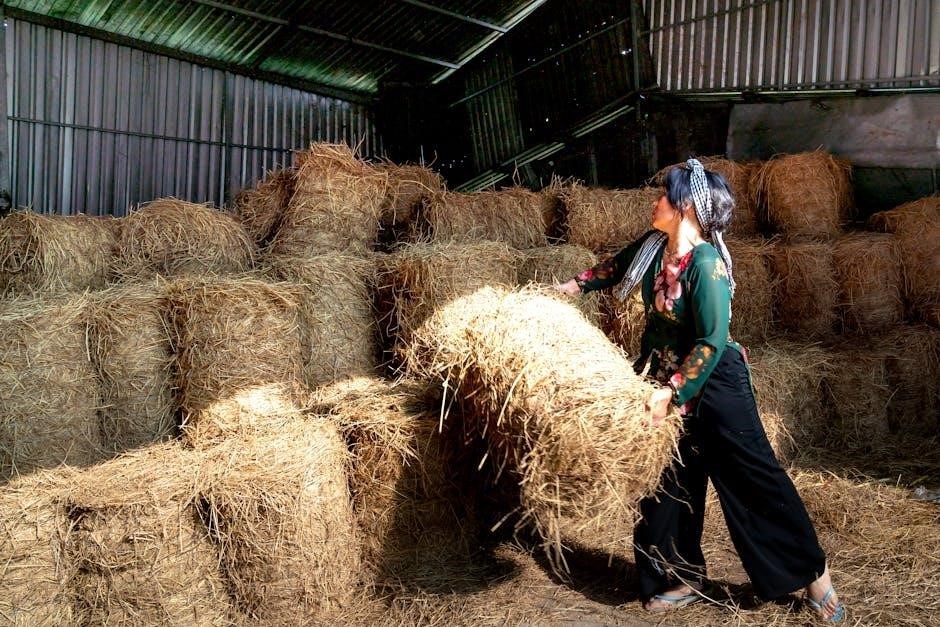
Hand-cranked balers represent a practical solution for small-scale farming operations where the investment in larger‚ mechanized equipment isn’t feasible. These balers rely entirely on human power‚ utilizing a crank mechanism to drive the compression and knotting processes. While requiring more physical effort‚ they offer affordability and simplicity‚ making them ideal for hobby farms or properties with limited acreage.
Typically‚ these balers are smaller in capacity‚ producing compact‚ easily manageable bales suitable for livestock or garden use. The slower operating speed allows for greater control over bale density and quality. They often feature adjustable settings to accommodate different hay types and desired bale sizes.

Despite their manual nature‚ hand-cranked balers embody the spirit of self-sufficiency and sustainable agriculture‚ offering a low-tech‚ reliable method for preserving hay for animal feed.
Pick-Up Balers: A Step Forward
Pick-up balers marked a significant advancement in manual hay baling technology‚ bridging the gap between earlier stationary models and fully automated systems. These balers incorporated a pick-up reel mechanism that gathered windrowed hay directly from the field‚ eliminating the laborious task of manually forking or pitching hay onto the baler.
This innovation substantially increased efficiency and reduced the physical strain on the operator. The pick-up reel gently lifted the hay and fed it into the compression chamber‚ streamlining the baling process. While still requiring manual cranking for compression and knotting‚ pick-up balers represented a considerable improvement in workflow.
They allowed farmers to cover more ground in a shorter amount of time‚ making hay harvesting more manageable‚ particularly on larger small farms. This design paved the way for the development of more sophisticated baling machinery.

Operational Mechanics of a Manual Hay Baler
Manual hay balers utilize compression mechanisms and knotting systems‚ often powered by hand cranks‚ to form dense bales for efficient storage and transport.
Hay Compression Mechanisms
The core function of a manual hay baler revolves around effectively compressing cut and raked crops. Early mechanisms‚ dating back to mid-1800s hay presses‚ relied on a simple yet powerful principle: weighted force. Horses would lift a substantial weight‚ and its subsequent drop generated the necessary pressure to compact the hay within the bale chamber.
As technology evolved‚ so did the compression methods. While still often manually operated‚ later balers incorporated levers and gears to amplify the force applied. These systems allowed farmers to achieve higher bale densities with less physical exertion. The bale chamber itself is crucial; its design dictates how uniformly the hay is compressed and the final shape of the bale.
Modern manual balers continue to utilize these fundamental principles‚ often employing a reciprocating plunger or a series of rollers to progressively compress the hay. The efficiency of the compression mechanism directly impacts the bale’s weight‚ size‚ and suitability for long-term storage and transport‚ making it a critical component of the baling process.
Knotting Systems and Twine Usage
Securing the compressed hay within a bale is paramount‚ and this is achieved through sophisticated knotting systems. Historically‚ manual balers relied heavily on natural fiber twine – often hemp or sisal – to bind the bales together. The knotting mechanism typically involves a series of trip levers and twine disks that wrap and tie the twine around the compacted hay at predetermined intervals.
The precision of the knotting system is crucial; a secure knot prevents the bale from unraveling during handling and transport. Adjusting twine tension is vital – too loose‚ and the bale falls apart; too tight‚ and the twine may break. Modern manual balers often utilize synthetic twines‚ offering increased strength and resistance to weathering.
Proper twine usage extends the life of the baler and ensures bale integrity. Regular inspection of the twine path and knotting components is essential to prevent jams and maintain optimal performance. Efficient knotting directly contributes to reduced hay loss and improved storage capabilities.
Bale Chamber Design and Capacity
The bale chamber within a manual hay baler is the core component dictating bale size and density. Early stationary balers featured large‚ fixed chambers within the barn structure‚ requiring significant manual labor for filling. Modern manual balers‚ particularly small square balers‚ employ a reciprocating chamber formed by moving parts like pistons or plates.
Chamber design directly influences bale density; tighter compression results in denser bales‚ reducing storage space and minimizing spoilage. Capacity‚ measured in bale weight or volume‚ varies depending on the baler model and the type of hay being processed. Smaller farms often favor balers with lower capacities for easier handling.
Optimizing chamber design involves balancing compression force‚ chamber size‚ and hay feed rate; Efficient chamber design minimizes hay loss and maximizes bale uniformity‚ contributing to overall operational efficiency and reduced waste;
Adjusting Bale Density and Size
Achieving optimal bale density and size is crucial for efficient hay storage and transport with a manual baler. Adjustments typically involve modifying compression settings‚ often through spring tension or hydraulic pressure controls on more advanced models. Increasing compression yields denser bales‚ ideal for long-term storage and reducing transport costs.
Bale size adjustments often relate to the stroke length of the compression mechanism or the chamber’s physical dimensions. Smaller bales are easier to handle manually‚ while larger bales reduce handling time but require more strength to move. Careful calibration is essential to prevent overfilling or under-compression.
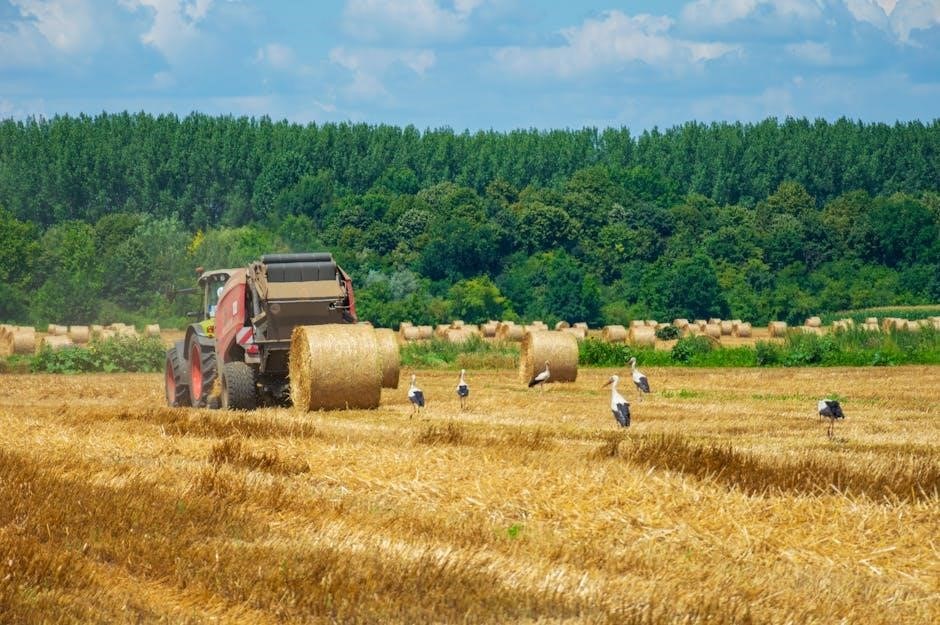
Regularly assessing bale weight and firmness allows operators to fine-tune settings based on hay type and moisture content‚ ensuring consistent bale quality and maximizing storage efficiency. Proper adjustment minimizes hay loss and optimizes the baler’s performance.
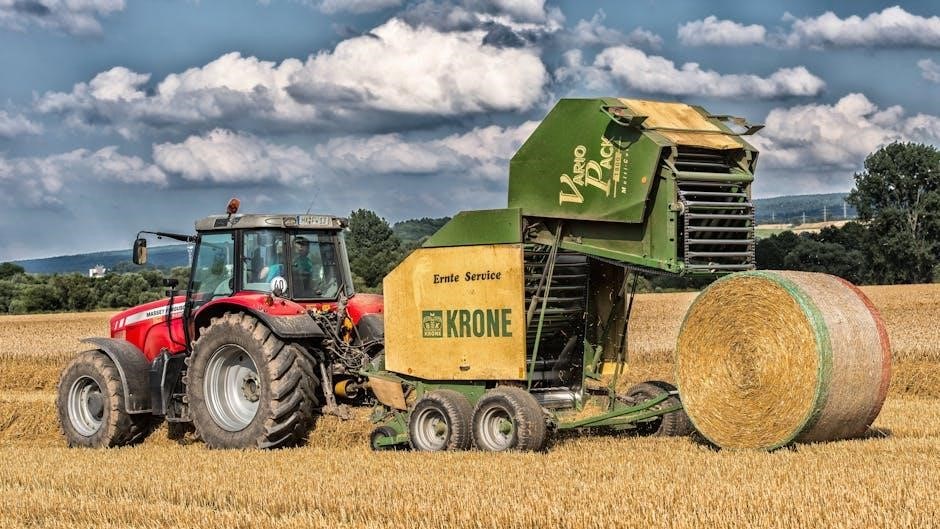
Maintenance and Troubleshooting
Regular inspection‚ lubrication‚ and swift resolution of common issues—like twine tension—are vital for a manual hay baler’s longevity and peak performance.
Regular Inspection Procedures
Consistent and thorough inspection is paramount for maintaining a manual hay baler’s operational efficiency and preventing costly breakdowns. Before each use‚ meticulously examine the bale chamber for any signs of damage‚ such as cracks or obstructions. Pay close attention to the knotting system‚ ensuring the twine is flowing smoothly and the knotter mechanisms are functioning correctly.
Inspect the drive chain or belt for wear and tear‚ adjusting tension as needed. Check all bolts and fasteners‚ tightening any that are loose. A visual assessment of the hay pickup teeth is crucial; replace any bent or missing teeth to ensure efficient hay intake. Regularly inspect the bale density mechanism‚ verifying its proper adjustment. Don’t neglect lubrication points – grease all moving parts according to the manufacturer’s recommendations. Finally‚ a quick check of twine supply is essential to avoid interruptions during baling operations. Proactive inspection saves time and resources.
Common Issues and Solutions
Several issues can arise with manual hay balers‚ but most are readily addressable. Frequent twine breaks often indicate insufficient twine tension or a malfunctioning knotter; adjust tension or replace worn knotter parts. Uneven bale density typically stems from uneven hay feed or improper density settings – ensure consistent hay flow and readjust the baler accordingly.
If the baler jams‚ immediately stop the machine and carefully remove the obstruction‚ avoiding injury. A slipping drive chain or belt usually requires tightening or replacement. Excessive wear on the pickup teeth can lead to hay loss; replace them promptly. Regularly cleaning the bale chamber prevents hay buildup and ensures smooth operation. If the knotter consistently fails‚ a thorough cleaning and lubrication of the mechanism may resolve the issue. Remember to consult the owner’s manual for specific troubleshooting guidance and safety precautions.
Twine Tension Adjustment
Proper twine tension is crucial for creating firm‚ well-formed bales that resist unraveling during handling and storage. Insufficient tension results in loose bales prone to falling apart‚ while excessive tension can lead to twine breakage and wasted material. Most manual balers feature an adjustable tension mechanism‚ often a spring-loaded system or a series of notched plates.
Begin with the manufacturer’s recommended setting and observe the bale formation. If the twine appears slack or the bales are loose‚ incrementally increase the tension. Conversely‚ if the twine breaks frequently‚ reduce the tension. Regularly check the twine path for obstructions that might affect tension consistency. Environmental factors‚ such as humidity‚ can also influence twine performance‚ requiring adjustments. Maintaining optimal twine tension ensures efficient baling and minimizes hay loss.
Lubrication and Cleaning
Consistent lubrication and thorough cleaning are paramount for extending the lifespan and maintaining the optimal performance of a manual hay baler. After each use‚ remove accumulated hay debris from all moving parts‚ including chains‚ gears‚ and the bale chamber. Dried hay can cause friction and wear‚ leading to premature failure.
Apply a high-quality‚ all-purpose lubricant to all grease fittings according to the manufacturer’s recommendations. Pay particular attention to the knotter mechanism and any bearings. Regularly inspect the twine disc for buildup and clean as needed. A clean and well-lubricated baler operates more efficiently‚ reduces strain on components‚ and minimizes the risk of breakdowns during peak haying season. Neglecting these tasks can result in costly repairs and downtime.
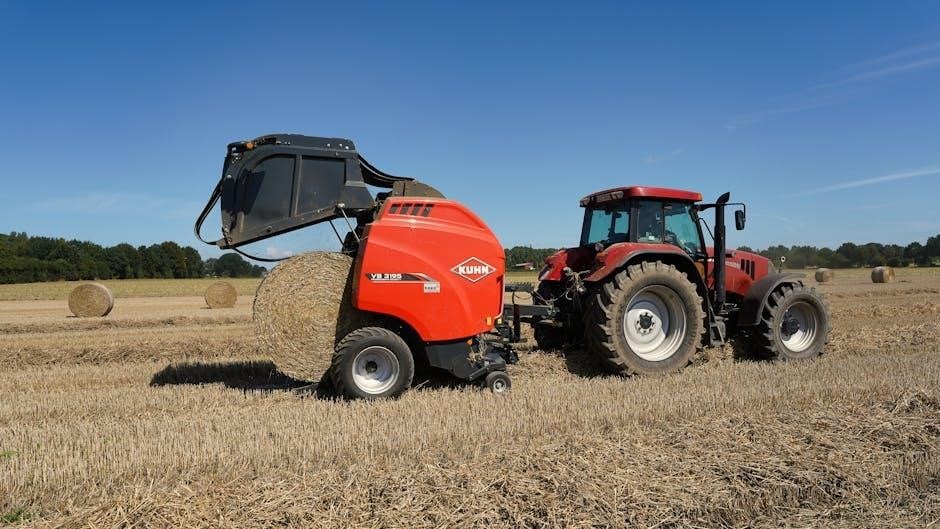
Modern Innovations and Future Trends
Manual balers continue to play a role in sustainable farming‚ integrating with modern raking techniques‚ though large round balers dominate‚ offering efficiency gains.
Integration with Modern Raking Techniques
The effectiveness of a manual hay baler is significantly enhanced when paired with contemporary raking methods. Modern rakes‚ whether side-delivery or wheel rakes‚ create consistent windrows‚ crucial for uniform bale density and efficient pickup by the baler. This synergy minimizes hay loss during the baling process‚ maximizing yield and quality.
Historically‚ raking was a more labor-intensive process‚ often impacting the consistency of the hay presented to early balers. Today’s rakes offer adjustable tines and controlled speeds‚ allowing farmers to tailor the windrow to the specific capabilities of their manual baler. Precise windrow formation reduces the need for multiple passes‚ saving time and fuel.
Furthermore‚ advancements in rake technology‚ such as automatic steering and load sensing‚ contribute to a smoother and more efficient baling operation. The integration isn’t simply about using newer equipment; it’s about understanding how the rake’s output directly influences the baler’s performance‚ leading to optimized hay harvesting.
Comparison with Large Round Balers
While large round balers dominate modern commercial hay production‚ manual hay balers retain distinct advantages for specific applications. Round balers excel in efficiency and handling large volumes‚ but produce bales requiring specialized equipment for moving and feeding. Manual balers create smaller‚ square bales easily manageable by hand or with smaller tractors.
The initial investment for a manual baler is considerably lower than that of a large round baler‚ making it accessible to small-scale farmers or those with limited capital. Furthermore‚ square bales offer greater versatility – ideal for livestock requiring smaller portions or for situations where storage space is constrained.
However‚ manual baling is more labor-intensive and slower. Round balers automate the process‚ reducing manpower needs. Ultimately‚ the choice depends on farm size‚ livestock type‚ budget‚ and desired level of automation. Both baler types fulfill essential roles in the agricultural landscape.
The Role of Manual Balers in Sustainable Farming
Manual hay balers contribute significantly to sustainable farming practices‚ particularly for smaller operations prioritizing ecological balance. Their lower energy consumption‚ compared to large‚ mechanized balers‚ reduces the carbon footprint of hay production. This aligns with a growing movement towards minimizing environmental impact in agriculture.
The smaller scale of manual baling often encourages more localized farming systems. Farmers can tailor hay production to specific livestock needs‚ reducing waste and promoting responsible land management. The bales themselves‚ being smaller‚ are easier to handle and distribute‚ fostering a closer connection between farmer and land.
Moreover‚ manual balers support biodiversity by allowing for the preservation of diverse hay meadows‚ often unsuitable for large-scale machinery. This contributes to healthier ecosystems and resilient agricultural landscapes‚ demonstrating the enduring value of traditional farming methods.
Alternative Bale Types and Applications
While traditionally associated with hay‚ manual balers demonstrate versatility extending beyond standard applications. They can effectively compress diverse crops like flax straw and silage‚ broadening their utility for various agricultural needs. This adaptability is particularly valuable for smaller farms diversifying their production.
Beyond agriculture‚ the principles of manual baling find application in recycling industries; Machines like aluminum can balers‚ though mechanized‚ utilize similar compression techniques to compact materials for efficient transport and processing. This highlights the broader relevance of bale formation technology.

Furthermore‚ the compact nature of bales produced by manual balers facilitates innovative uses‚ such as building materials for temporary shelters or garden structures. Exploring these alternative applications enhances the economic viability and sustainability of small-scale farming operations‚ showcasing the enduring practicality of this agricultural tool.